Does a flat fee go in the trust account or straight into operating?
You take $3,500 up front to handle a case through trial. Whether that money is yours on the day it clears depends on your state rule, and getting it wrong is the most common trust violation in a flat-fee practice.
A client hands you $3,500 to take a case through trial. The work will happen over the next eight months. The question is whether that money is yours today, and the answer decides which account it goes into, what happens if the client fires you in week three, and whether a fee dispute stays a fee dispute.
The default answer in most states is that the fee is unearned when you receive it, which makes it your client's property and puts it in the trust account until you earn it. A minority of jurisdictions let you deposit a flat fee straight into operating if you meet specific written conditions. Both positions come with obligations, and the label on your fee agreement does not decide which one applies to you.
Where your state probably lands.
Read your own rule before you set up the account. These are the three patterns you will find.
Trust until earned, the majority rule
An advance fee is client property. It goes to the trust account and moves to operating in the amounts you earn. This is the safe default, and it is what most bars expect when they open a file on you.
Operating, with written consent
Some states let a flat fee go to operating if the client agrees in writing after you disclose that unearned amounts are refundable. California, for one, permits it under Rule 1.15 with that disclosure, and requires the agreement in writing once the fee reaches a set threshold.
The true retainer, which is rare
A payment purely for your availability, earned when paid because it buys the right to call on you. Courts read this narrowly. If the money is really a prepayment for work, calling it a true retainer in the engagement letter does not convert it into one.
The word "nonrefundable" does less than firms think. ABA Formal Opinion 505, issued in 2023, took the position that fees paid in advance are refundable to the extent they are unearned, and that describing them as nonrefundable in an engagement letter is improper. Whatever your state does about which account the money sits in, a client who terminates you early is generally entitled to the part you have not yet earned. That is the obligation the account choice does not remove.
How to earn a flat fee in stages.
Define what earns what
Split the fee across the stages of the matter in the engagement letter: arraignment, preliminary hearing, motions, trial preparation, trial. A client reading it should know what they are buying and what a refund would look like at each point.
Deposit to trust
Unless your state and your written agreement clearly permit otherwise, the fee goes to the client trust account. Record it against that client's ledger, not as a lump sum in the account.
Transfer as each stage completes
Mark the stage done, then move that portion from trust to operating as its own transaction with its own date and reason. Moving money in round numbers when cash is tight is the pattern that draws attention.
Tell the client what moved
Many states require notice when you take funds from trust. A short statement showing the stage completed and the amount transferred satisfies it and heads off the argument about what you actually did for the money.
Refund the balance if it ends early
If the client leaves after the preliminary hearing, the unearned portion goes back. Because you defined the stages up front, the figure is arithmetic rather than a negotiation about the value of your time.
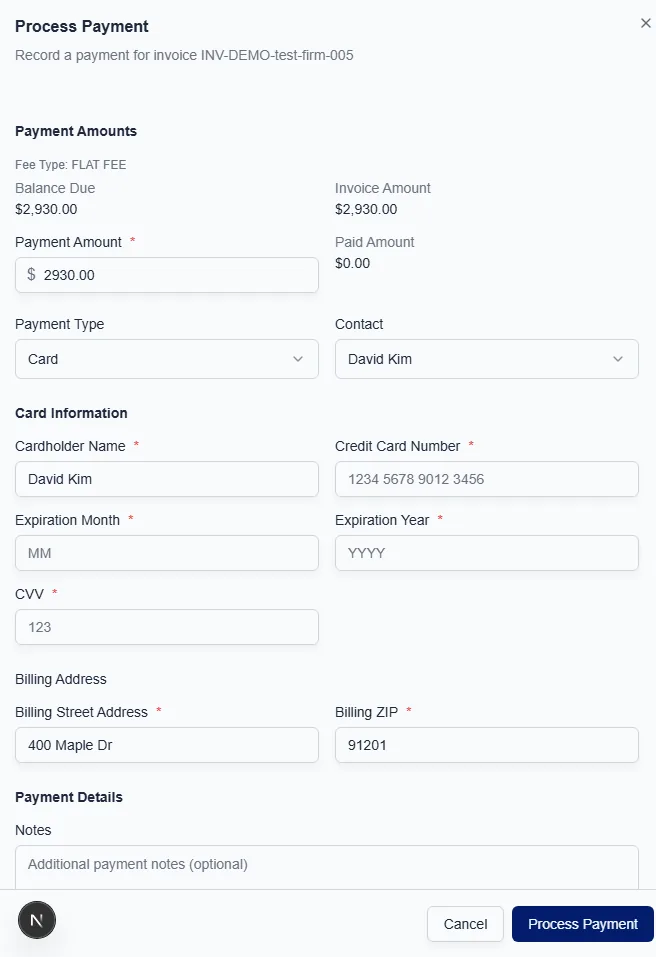
The fee is one number. The ledger is five.
Doing this by hand means a trust deposit in one system, a fee agreement in a folder, a note about which stage you reached, and a transfer somebody remembers to make. CaseFuze holds the stages against the matter, moves the earned portion when you mark a stage complete, and records the transfer with its date and reason on the client's own ledger.
- The unearned balance is always visible. Open the matter and see what is still your client's money, without adding up transfers.
- Refunds calculate themselves. The client who leaves in week three gets a figure that came from the ledger, with the working shown.
- No transfer without a record. Every movement from trust to operating carries who moved it, when, and against which stage.
Take the fee today. Sleep tonight.
Define your stages once and every flat fee after that draws down on its own, with the trust ledger, the client notice, and the refund figure all falling out of the same record. Trust accounting is in the $49 plan rather than a compliance tier, and we move your existing balances across at no charge.
Common questions about flat fees and trust.
Can I write "nonrefundable" in the engagement letter?
My state lets me deposit flat fees into operating. Should I?
What if the case resolves faster than expected?
Can I take a flat fee and a costs deposit together?
Do I have to notify the client every time I move money?
The software that does this for you.
CaseFuze handles the ledger, the statement, and the checks. $49 per user per month.