How to do a three-way reconciliation on your IOLTA account
Three numbers have to agree: your bank statement, your trust ledger, and the sum of every client balance. Here is how to reconcile an IOLTA account each month, and what to do on the morning they do not match.
A three-way reconciliation asks whether three numbers agree. The adjusted balance on your trust bank statement, the running balance in your trust ledger, and the total of every individual client balance you are holding. If all three match, the money in the account is accounted for. If they do not, you are holding an amount you cannot explain, and the explanation is what bar counsel will want.
Most jurisdictions require this monthly and require you to keep the reconciliation for five to seven years. The reconciliation itself is arithmetic. The part that takes an afternoon is finding the difference when the three numbers disagree, which is why the sixth section below is longer than the rest.
Six steps, once a month.
Start from the bank statement
Take the closing balance from the trust account statement. This is the only one of the three numbers you did not produce yourself, so it anchors the other two.
Adjust for what the bank has not seen
Add deposits that have not yet posted. Subtract checks you have written that have not yet cleared. The result is the adjusted bank balance, which is what you should actually be holding.
Compare it to your trust ledger
Your ledger is the running record of every deposit and disbursement across the whole account. Its balance should equal the adjusted bank balance. Two numbers down, one to go.
Add up every client balance
List each client you are holding money for and what you hold for them. Total the list. This is the number most firms cannot produce quickly, and it is the one that matters most, because it is the only figure that shows whether one client's funds are covering another client's disbursement.
Confirm all three agree
Adjusted bank balance, ledger balance, and the sum of client balances. One number, three ways of arriving at it. No client balance should ever be negative, even for a day.
Sign it and keep it
Print or export the reconciliation with the date and who performed it. Most states want it retained for at least five years and want it available on demand. A reconciliation you did but cannot produce counts as one you did not do.
July reconciliation
BalancedThe reconciliation is not the work. Finding the break is.
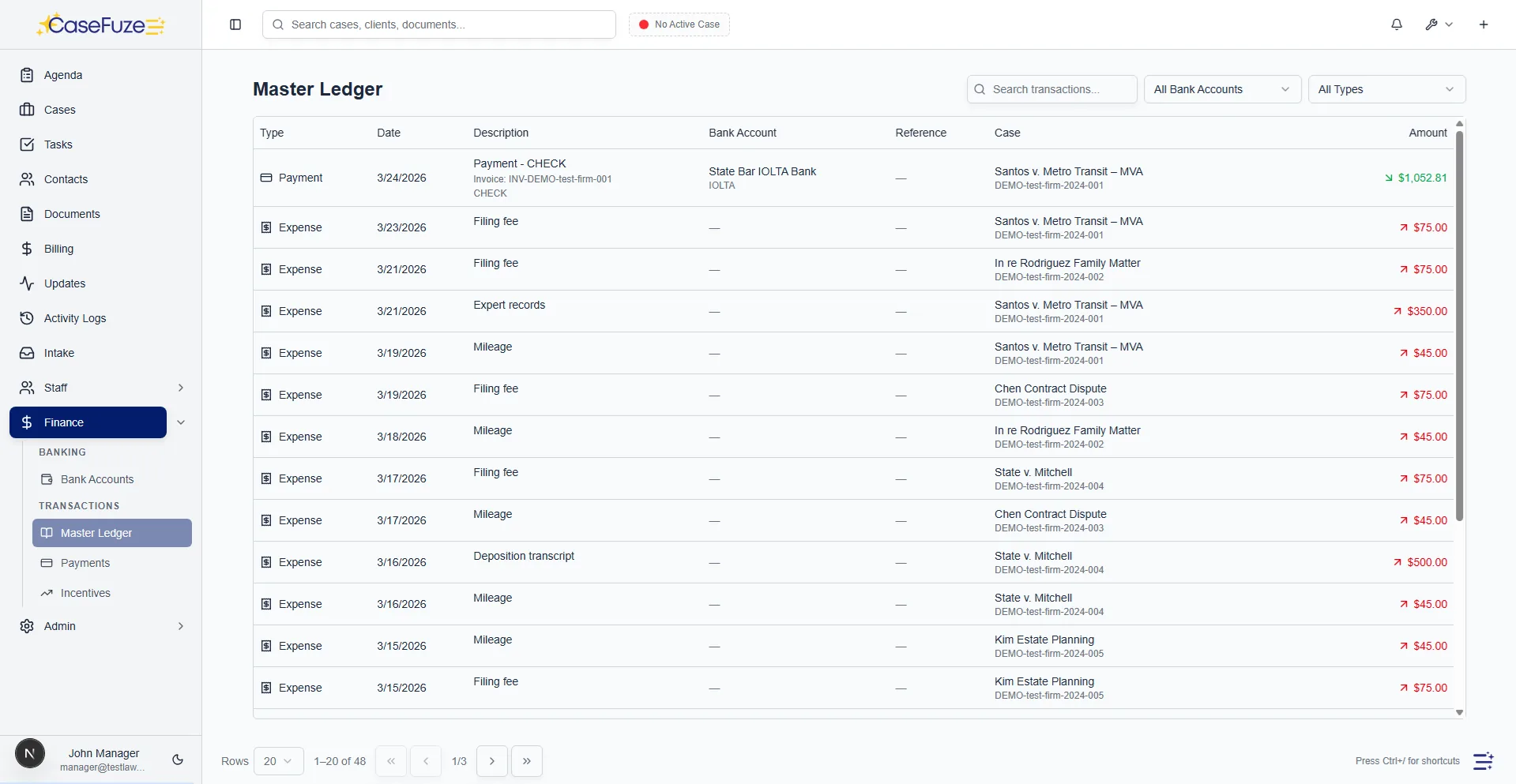
A firm doing this by hand exports a statement, opens a spreadsheet of client balances that somebody maintains separately, and hopes the two agree. When they do not, the search covers a month of transactions with no way to tell which day the difference started. CaseFuze keeps the three figures in step continuously against a read-only bank feed, so a break surfaces on the day it happens rather than on the fourth of next month.
- Client balances are never pooled. Each client has their own ledger, so the sum is a query rather than a spreadsheet somebody keeps current by hand.
- A disbursement cannot overdraw a client. If a payment would take one client's balance below zero, it stops at entry instead of quietly borrowing from the client next to them.
- Corrections are adjustments, not overwrites. Every entry keeps who made it and when, which is the trail that shows a mistake was a mistake.
Six things that cause the difference.
Work down this list before assuming the worst. In order of how often each one turns out to be the answer.
A check you forgot was outstanding
Written in March, never presented, and dropped off your mental list. It still reduces what you can disburse. Age your outstanding checks and chase anything over ninety days rather than carrying it forever.
Bank fees taken out of trust
Wire fees, statement charges, or a monthly maintenance fee debited from the trust account spends client money on a firm expense. Move the account to a fee arrangement that bills operating, and reimburse anything already taken.
Card processing fees netted on the way in
A processor that deposits $970 against a $1,000 retainer and takes its fee off the top has taken it from your client. Use a processor that debits fees to operating, which is a standard legal-specific arrangement.
A disbursement on the wrong client ledger
The account total still balances, so the first two numbers agree and only the client sum reveals it. One client shows a shortfall and another shows a surplus by the same amount. This is the most common reason a three-way breaks when a two-way would not have.
An earned fee still sitting in trust
You billed against a retainer and never moved the money to operating. It is not a shortfall, but it makes the client sum disagree with your ledger and it leaves your own money in a client account, which is its own problem.
A transposition
$4,150 entered as $4,510. If the difference divides evenly by nine, you are almost certainly looking at two digits that swapped places. Old bookkeeping trick, still the fastest way to find one.
Reconciled before your coffee goes cold.
Connect the trust account once and CaseFuze keeps the bank, the ledger, and all thirty-four client balances in agreement between reconciliations. The monthly close becomes a report you export and sign instead of a Saturday you lose. Migration of your existing balances costs nothing.
Common questions about trust reconciliation.
How often do I have to reconcile?
What is the difference between a two-way and a three-way reconciliation?
Can a client balance be negative for a day or two?
Who at the firm should perform the reconciliation?
What do I do about IOLTA interest?
How long do I keep the reconciliations?
The software that does this for you.
CaseFuze handles the ledger, the statement, and the checks. $49 per user per month.